
 Русский
  English
  Deutsch
  Español
  العربية
  中文
中文  Türkçe
  Français
  Italiano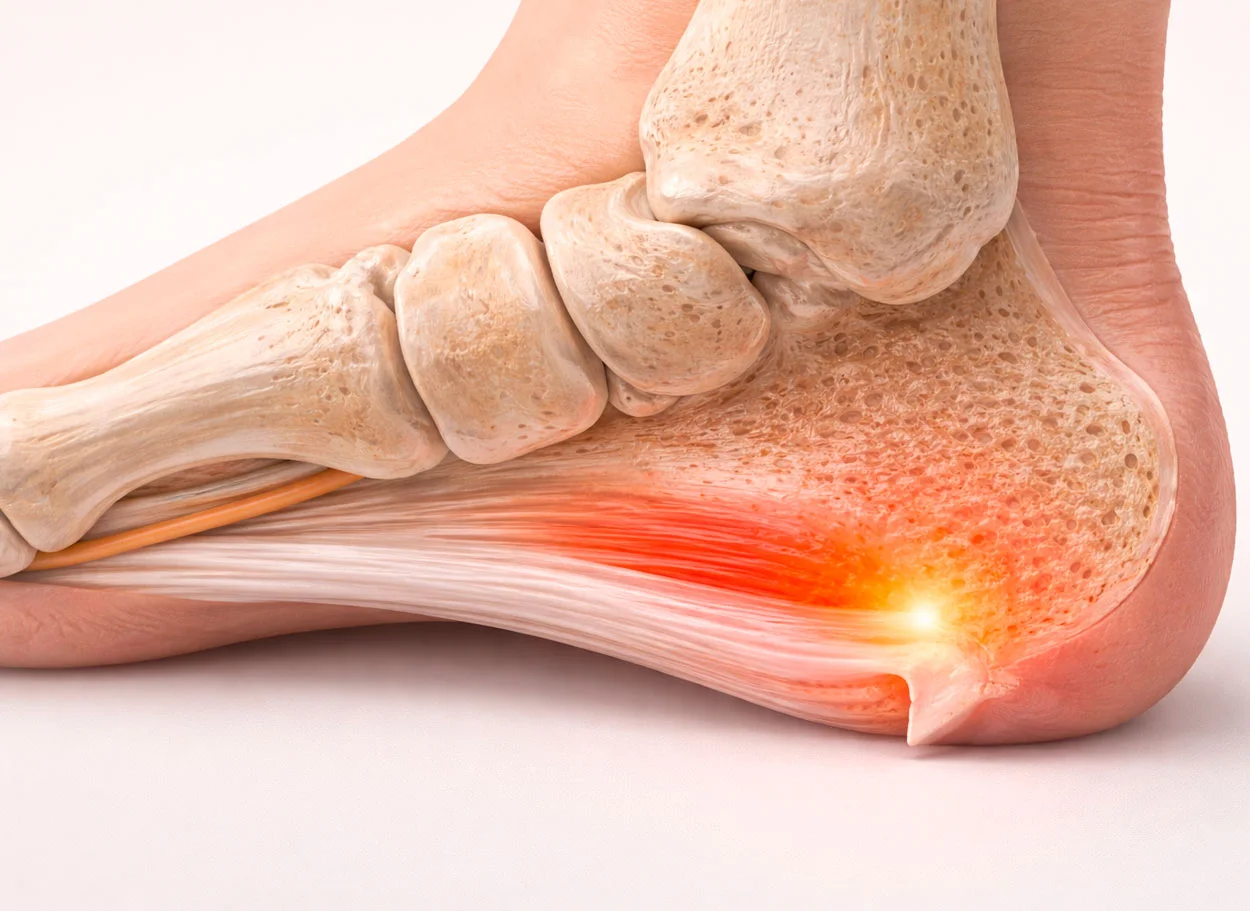
What is a heel spur?
Heel spur (plantar fasciitis) is a degenerative-inflammatory lesion of the plantar fascia at its attachment to the calcaneus. It is often accompanied by bone outgrowth (osteophyte) on the plantar surface of the calcaneus — the actual "spur."
This is the most common cause of heel pain — about 10% of the population experiences this problem during their lifetime. Peak incidence is 40-60 years. In runners, the frequency reaches 10-22%.
What actually hurts?
Contrary to popular belief, the pain is not caused by the "spur" (osteophyte) itself, but by degeneration and microtears of the plantar fascia. 15-25% of people with spurs have no symptoms on X-ray. The correct term is plantar fasciopathy.
Risk factors:
- Excess weight (BMI > 30)
- Prolonged standing (occupation)
- Flat feet or high foot arch
- Long-distance running
- Tight calf muscles and Achilles tendon
- Inappropriate footwear
Facts about heel spurs
- ICD-10: M77.3
- Prevalence: 10% of population
- Peak: 40-60 years
- In runners: 10-22%
- Chronicity: 10-20% without treatment
- Bilateral: up to 30% of cases
Symptoms of heel spurs
Typical presentation
- Sharp heel pain with first steps in the morning
- Pain "as if stepping on a nail"
- Pain decreases after walking around
- Pain worsens by evening
- Tender spot on the heel sole
Progression
- Pain with every step
- Limping, favoring the foot
- Pain at rest
- Overload of the healthy foot
- Secondary knee and low back pain
Chronic form
- Pain for more than 6 months
- Insoles and physical therapy do not help
- Multiple blockades without effect
- Inability to engage in sports
- Limitation of daily activities
Traditional treatment vs MIBRAR®
| Criterion | Corticosteroids | Shockwave (ESWT) | MIBRAR® |
|---|---|---|---|
| Principle | Suppression of inflammation with hormones | Destruction of scar tissue with shockwave | Regeneration of fascia with stem cells |
| Duration of effect | 2-6 months | 6-12 months (if successful) | Long-term regeneration |
| Number of sessions | 1-3 injections (no more!) | 3-5 sessions | 1 procedure |
| Fascia regeneration | ❌ No — corticosteroids weaken tissue | Partial (stimulation of healing) | ✅ Complete regeneration |
| Risk of fascia rupture | Increased (up to 10% with repeated injections) | Low | Absent — tissue is strengthened |
| Painfulness of procedure | Moderate | Significant | Minimal |
How MIBRAR® treats Heel Spur (Plantar Fasciitis)
Ultrasound diagnostics
Sono Control Arm™ visualizes the plantar fascia: measures thickness (normal <4 mm, in fasciitis >4.5 mm), identifies areas of degeneration, microtears, and neovascularization.
Obtaining concentrates
CGF — growth factors with anti-inflammatory effects and collagenogenesis stimulation. Lipogems® — stem cells for fascia structure restoration.
Injection into damage zone
Under ultrasound control, concentrates are injected directly into the fascia degeneration zone — at the attachment to the heel bone and along the thickened section.
Fascia regeneration
Stem cells restore normal collagen structure of the fascia, eliminate degeneration and microtears. Anti-inflammatory factors relieve pain. Result — restoration of healthy tissue in 4-8 weeks.
Why MIBRAR® is effective for Heel Spur (Plantar Fasciitis)
Heel Spur (Plantar Fasciitis) is not inflammation, but collagen degeneration of the plantar fascia (fasciosis). Steroids temporarily relieve pain but weaken tissue — risk of complete rupture. ESWT mechanically stimulates healing but does not restore structure. MIBRAR® is the only method providing true regeneration: Lipogems® stem cells synthesize type I collagen, restoring normal fascia architecture. CGF growth factors suppress neovascularization (pain source) and stimulate angiogenesis of healthy vessels.
MIBRAR® Method Advantages
95% of interventions covered
MIBRAR® covers up to 95% of all spinal neurosurgery and orthopedic operations.
No anesthesia or incisions
Outpatient treatment via 0.3-1.5 mm puncture. No general anesthesia or hospitalization.
No age restrictions
Regeneration at any age. Safe for chronic conditions and anesthesia intolerance.
Rapid improvement
Concentrates have analgesic and anti-inflammatory properties. Relief within days.
Multiple zones at once
Simultaneous treatment of multiple discs or joints in one procedure.
Home the same day
No crutches, braces or rehabilitation needed. MRI follow-up at 8-16 weeks.
MIBRAR® Technology
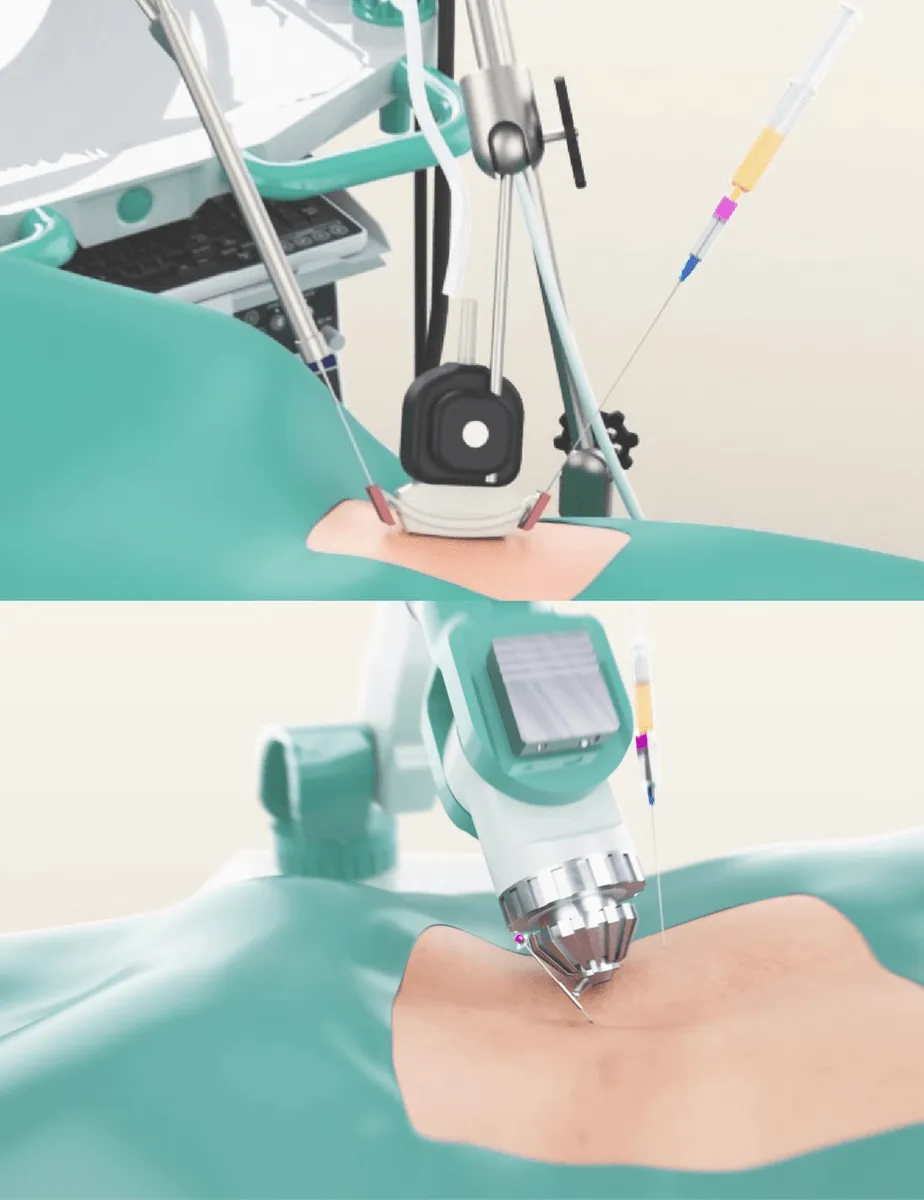
Cyber Navi Hand™
Intraoperative robotic navigation system. Provides precise access to deep structures with 1 mm and 1 degree accuracy.

Sono Control Arm™
Device for intervention under sonographic control. Eliminates open surgeries with real-time visual monitoring.