
 Русский
  English
  Deutsch
  Español
  العربية
  中文
中文  Türkçe
  Français
  Italiano
What is Thumb Basal Joint Arthritis?
Thumb Basal Joint Arthritis (Rhizarthrosis) is osteoarthritis of the carpometacarpal (CMC) joint of the thumb. It is one of the most common hand arthropathies, affecting up to 15% of women and 7% of men over 50 years old. The thumb participates in 40% of all hand functions, so its involvement critically reduces quality of life.
Traditional surgical treatment — trapezium removal or joint replacement — requires prolonged rehabilitation and does not always restore grip strength.
Symptoms:
- Pain at the base of the thumb during grasping and pinching
- Weak grip — difficulty opening jars, turning keys
- Swelling and deformity in the anatomical snuffbox area
- Crepitus with movement
- Limited thumb abduction
Stages (Eaton-Littler Classification):
- I — joint space narrowing, minimal changes
- II — osteophytes, joint space narrowing less than 2 mm
- III — marked osteophytes, subluxation, cysts
- IV — involvement of adjacent STT joint
Facts about Thumb Basal Joint Arthritis
- ICD-10: M18.1
- Prevalence: 15% of women over 50
- Gender: women affected 2 times more often
- Thumb function: 40% of hand functions
- Surgery: rehabilitation 3-6 months
How MIBRAR® Treats Thumb Basal Joint Arthritis
Ultrasound Diagnostics
Sono Control Arm™ visualizes the CMC joint, assesses cartilage thickness, presence of osteophytes and subluxation.
Concentrate Preparation
CGF — chondrogenic and anti-inflammatory factors. Lipogems® — stem cells for cartilage regeneration.
Microinjection into CMC Joint
Under ultrasound guidance, concentrates are injected directly into the small CMC joint. Navigation precision is critical for such a small joint.
Cartilage Regeneration
Stem cells differentiate into chondrocytes, restoring the joint surface. Result — pain reduction, restoration of grip strength.
MIBRAR® Method Advantages
95% of interventions covered
MIBRAR® covers up to 95% of all spinal neurosurgery and orthopedic operations.
No anesthesia or incisions
Outpatient treatment via 0.3-1.5 mm puncture. No general anesthesia or hospitalization.
No age restrictions
Regeneration at any age. Safe for chronic conditions and anesthesia intolerance.
Rapid improvement
Concentrates have analgesic and anti-inflammatory properties. Relief within days.
Multiple zones at once
Simultaneous treatment of multiple discs or joints in one procedure.
Home the same day
No crutches, braces or rehabilitation needed. MRI follow-up at 8-16 weeks.
MIBRAR® Technology
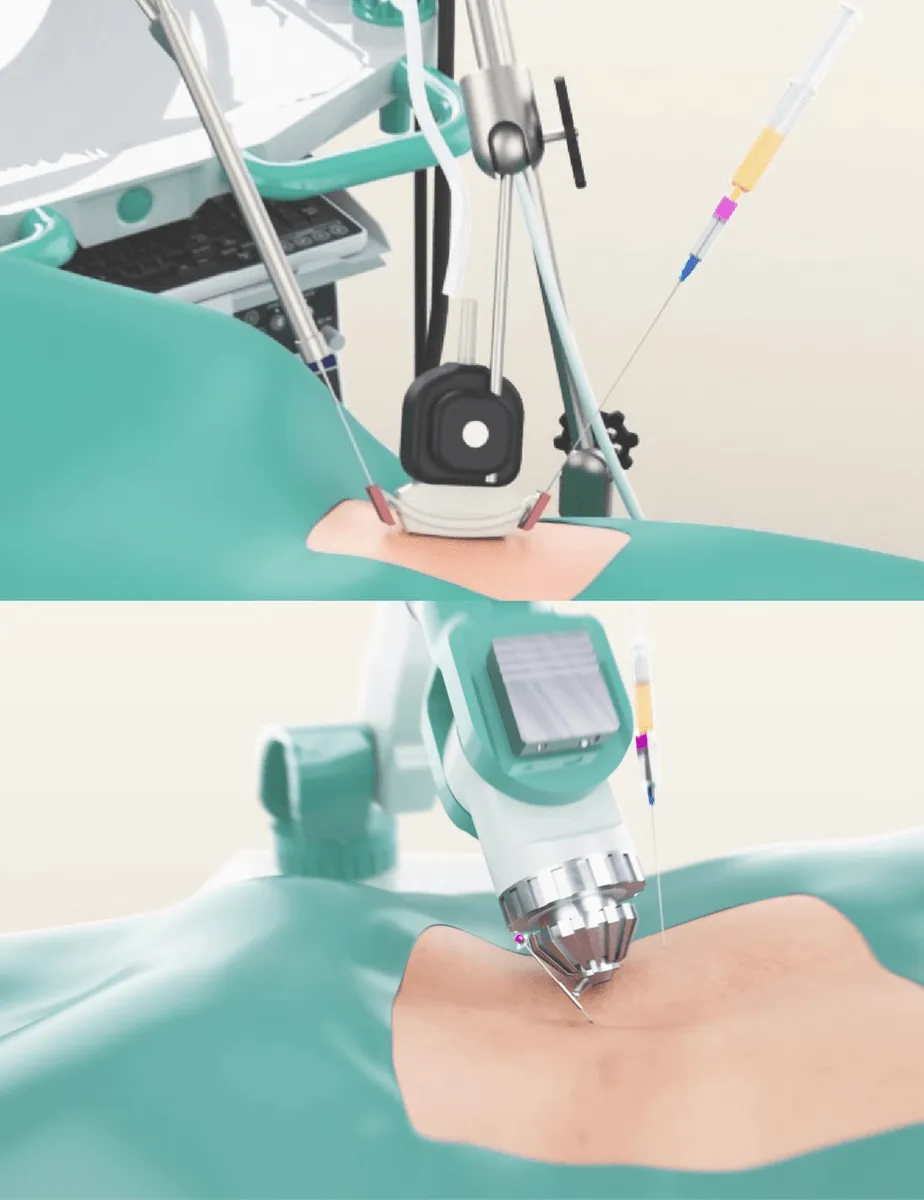
Cyber Navi Hand™
Intraoperative robotic navigation system. Provides precise access to deep structures with 1 mm and 1 degree accuracy.

Sono Control Arm™
Device for intervention under sonographic control. Eliminates open surgeries with real-time visual monitoring.