
 Русский
  English
  Deutsch
  Español
  العربية
  中文
中文  Türkçe
  Français
  Italiano
What is Failed Back Surgery Syndrome (FBSS)?
Failed Back Surgery Syndrome (FBSS) is a condition in which the patient continues to experience pain after spine surgery, or the pain returns some time after the operation. This is not the surgeon's fault in most cases — the problem lies in the approach itself: surgery removes damaged tissue but does not restore it.
According to statistics, up to 40% of patients after spine surgeries (microdiscectomy, laminectomy, spinal fusion) do not receive the expected relief or experience new problems. With repeat surgeries, the percentage of dissatisfied results is even higher — up to 65-70%.
Causes of FBSS:
- Hernia recurrence — repeated disc protrusion at the operated level (15-25% of cases)
- Epidural fibrosis — scar and adhesive changes in the spinal canal compressing nerve roots
- Segmental instability — after partial disc removal, the spinal segment loses stability
- Adjacent segment syndrome — after spinal fusion, adjacent segments degenerate faster due to overload
- Incomplete decompression — nerve remained partially compressed
- Nerve structure damage — intraoperative nerve injury
FBSS Facts
- ICD-10: M96.1
- Frequency: 10-40% after first surgery
- After repeat: up to 65-70% dissatisfied
- Most common cause: epidural fibrosis
- Problem: each subsequent surgery worsens the prognosis
Manifestations of FBSS
Pain Syndrome
- Pain returns weeks-months after surgery
- New pain character (burning, shooting)
- Pain at the surgical scar site
- Chronic pulling pain in the lower back
- Leg pain (sciatica recurrence)
Neurological Symptoms
- Numbness and paresthesias in the extremities
- Muscle weakness
- Sensory disturbances in new areas
- Neuropathic pain (burning, "electric shocks")
- Limited mobility
Vicious Cycle of FBSS
- First surgery → scarring → pain
- Second surgery → more scars → more pain
- Each surgery worsens the anatomy of the area
- Traditional medicine offers neurostimulators or painkillers
- MIBRAR® breaks this vicious cycle
How MIBRAR® helps with FBSS
MIBRAR® is the only method that addresses all causes of FBSS simultaneously: scars, recurrent herniation, instability, inflammation. Cyber Navi Hand™ navigation ensures safe access even in areas with altered anatomy after previous surgery.
Analysis of Postoperative Changes
Contrast-enhanced MRI is analyzed using Cyber Navi Hand™. Identified: zones of epidural fibrosis, recurrent herniation, instability, degeneration of adjacent segments. A 3D plan is created taking into account altered anatomy after previous surgery.
Obtaining Concentrates
From blood — CGF with powerful anti-inflammatory and antifibrotic effects. From adipose tissue — Lipogems® with stem cells capable of resorbing scar tissue and restoring normal structures.
Targeted Injection
Under navigational control, concentrates are injected into fibrosis zones (to resorb scars), into recurrent herniation (for disc regeneration), around nerve roots (for neuroprotection), into weakened ligaments (for stabilization).
Regeneration and Remodeling
Stem cells initiate resorption of scar tissue and its replacement with normal structures. Simultaneously, disc regeneration, ligament strengthening, and nerve blood supply restoration occur. The process takes 3-6 months.
Why MIBRAR® is effective for FBSS
The main problem of FBSS is the vicious cycle: each repeat surgery creates even more scar tissue, worsening the situation. Neurostimulators and painkillers only mask the pain. MIBRAR® is the only method that can break this cycle, addressing the causes of FBSS without creating new damage.
How MIBRAR® works for FBSS:
- Antifibrotic effect — mesenchymal stem cells (Lipogems®) release matrix metalloproteinases (MMP) that break down excess collagen in scar tissue, replacing it with normal structures
- Disc regeneration — in recurrent herniation, stem cells restore the damaged disc from within, preventing re-extrusion
- Neuroprotection — nerve growth factors restore damaged nerve fibers, reducing neuropathic pain
- Biological stabilization — strengthening of ligaments and muscles without metal constructs, preserving mobility
Key advantage: MIBRAR® does not create new damage. A 0.3-1.5 mm puncture heals in hours without leaving scars. This fundamentally differs from repeat surgery, which inevitably increases fibrosis volume.
Advantages of MIBRAR® for FBSS
- No repeat surgery — 0.3-1.5 mm puncture
- Scar resorption — antifibrotic effect
- Disc regeneration — for recurrent herniation
- Neuroprotection — nerve restoration
- No general anesthesia — local anesthesia
- Cyber Navi Hand™ navigation — safety in altered zones
Treatment Results for FBSS
Follow-up MRI scans confirm tissue regeneration and nerve structure decompression even after failed spinal surgeries.

MIBRAR Case: female, 43 years
Diagnosis: condition after radiofrequency nucleotomy. Complete disc wear L5/S1, pseudoretrolisthesis L4 and L5, neuroforaminal stenosis, lumbosacral destabilization. Lateral X-ray with color-coded sagittal balance.
Result at 18 months: complete disc height reconstruction, sagittal balance restoration, retrolisthesis elimination. One week post-procedure — complete symptom resolution.
View case study →
Same patient — frontal projection
AP X-ray: color markings show axial load disruption and lateral vertebral displacement after nucleotomy (green arrow).
At 18 months: spinal axis restoration, intervertebral space symmetry, increased disc height. MIBRAR® restored what the previous surgery destroyed.
View case study →MIBRAR® Method Advantages
95% of interventions covered
MIBRAR® covers up to 95% of all spinal neurosurgery and orthopedic operations.
No anesthesia or incisions
Outpatient treatment via 0.3-1.5 mm puncture. No general anesthesia or hospitalization.
No age restrictions
Regeneration at any age. Safe for chronic conditions and anesthesia intolerance.
Rapid improvement
Concentrates have analgesic and anti-inflammatory properties. Relief within days.
Multiple zones at once
Simultaneous treatment of multiple discs or joints in one procedure.
Home the same day
No crutches, braces or rehabilitation needed. MRI follow-up at 8-16 weeks.
MIBRAR® Technology
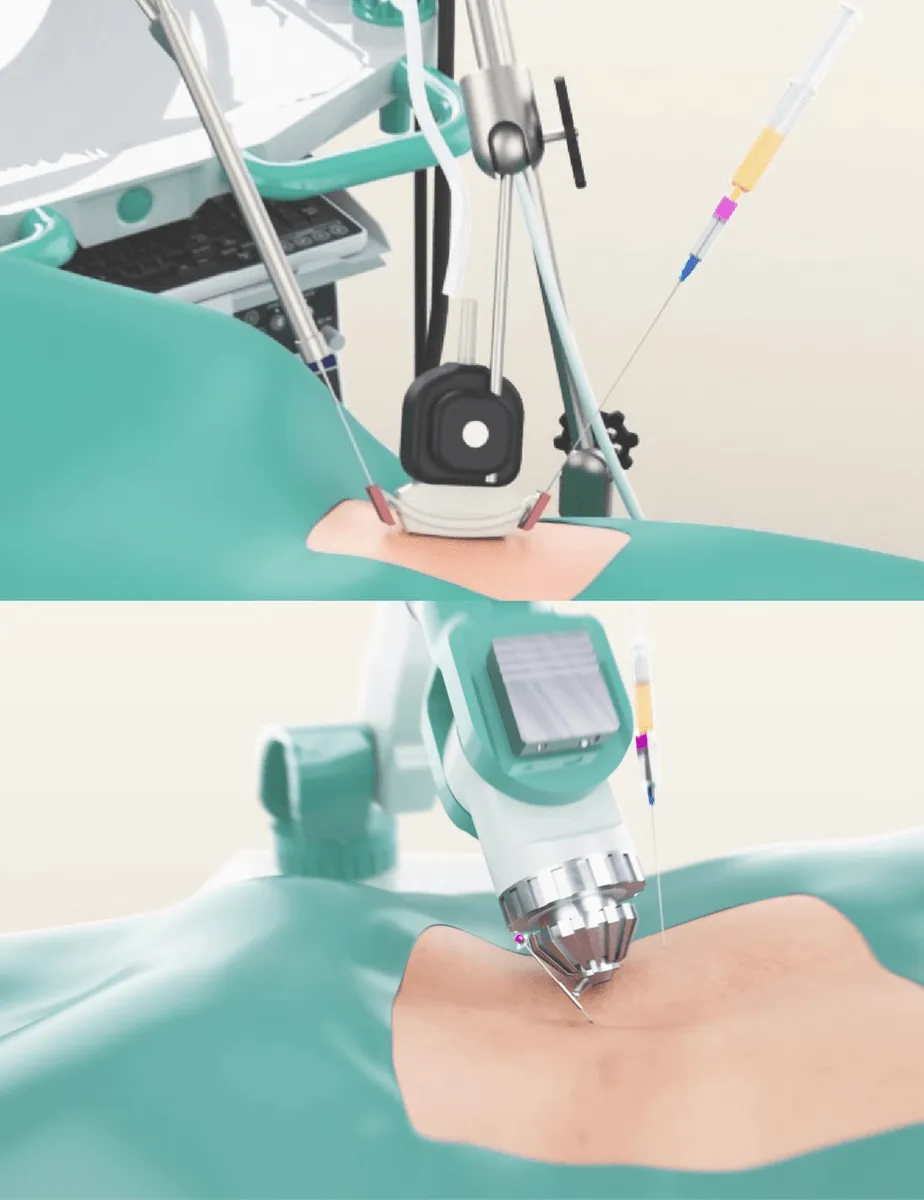
Cyber Navi Hand™
Intraoperative robotic navigation system. Provides precise access to deep structures with 1 mm and 1 degree accuracy.

Sono Control Arm™
Device for intervention under sonographic control. Eliminates open surgeries with real-time visual monitoring.