 Русский
  English
  Deutsch
  Español
  العربية
  中文
中文  Türkçe
  Français
  Italiano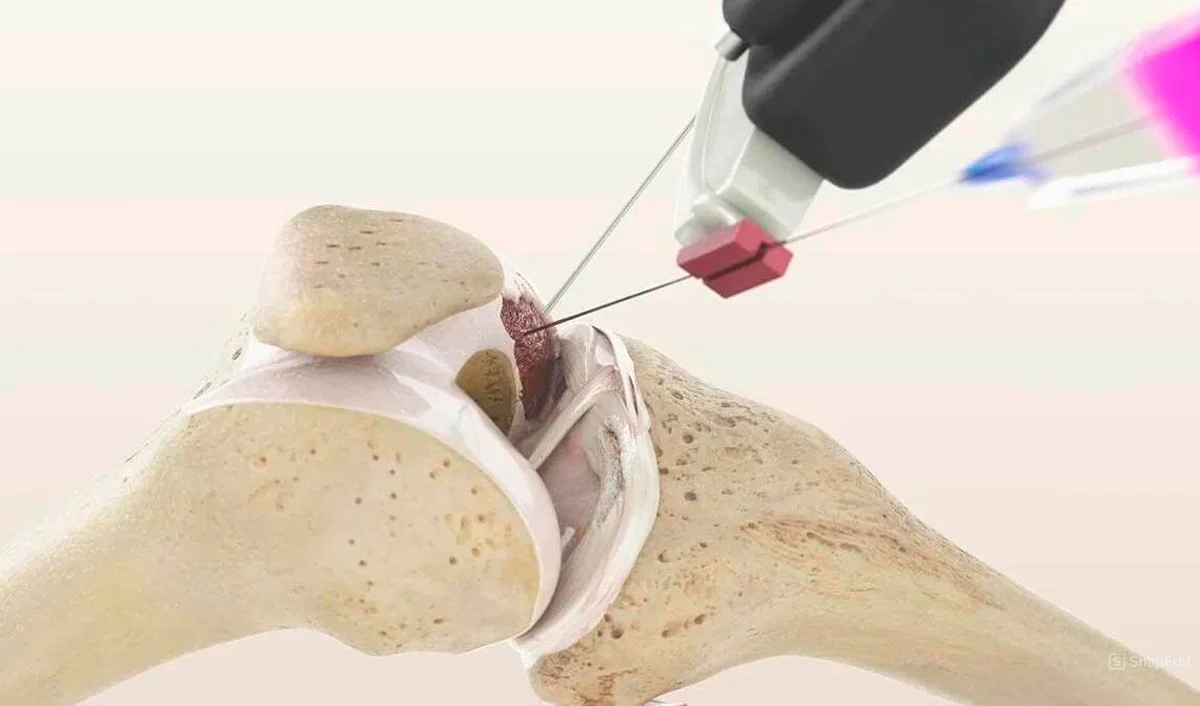
What is knee osteoarthritis (gonarthrosis)?
Knee osteoarthritis (gonarthrosis) is a degenerative-dystrophic disease in which the cartilage tissue of the knee joint is destroyed, leading to pain, limited mobility, and deformity. Read more about the stages of the disease in our article on the 4 stages of gonarthrosis.
This is the most common osteoarthritis disease. According to WHO data, about 10% of men and 13% of women over 60 suffer from gonarthrosis. In Germany, more than 190,000 knee joint replacement surgeries are performed annually — this is one of the most common orthopedic procedures.
Stages of gonarthrosis (Kellgren-Lawrence):
- Grade I — doubtful radiographic signs, minimal osteophytes
- Grade II — moderate joint space narrowing, definite osteophytes
- Grade III — significant joint space narrowing, subchondral sclerosis, multiple osteophytes
- Grade IV — marked joint space narrowing, large osteophytes, deformation of bone contours
Types of involvement:
- Medial — involvement of the medial compartment (most common)
- Lateral — involvement of the lateral compartment
- Patellofemoral — involvement of the patella
- Total — involvement of all compartments
Facts about knee osteoarthritis (gonarthrosis)
- ICD-10: M17
- Prevalence: 10-13% of population over 60 years
- Gender: women affected 1.5-2 times more often
- Joint replacement: 190,000+ surgeries/year in Germany
- Obesity: increases risk 4-5 times
Symptoms of knee osteoarthritis (gonarthrosis)
Early signs
- Pain when climbing stairs
- Morning stiffness (up to 30 minutes)
- Crunching (crepitus) in the knee
- Discomfort after prolonged sitting
- Intermittent joint swelling
Progression
- Constant pain while walking
- Limited flexion/extension
- Joint instability
- Varus or valgus deformity
- Synovitis (joint effusion)
Late Stages
- Pain at rest and at night
- Marked leg deformity (O- or X-shaped)
- Inability to fully extend
- Quadriceps muscle atrophy
- Need for cane or crutches
Knee Prosthesis vs MIBRAR®
| Criterion | Total Joint Replacement | Arthroscopy | MIBRAR® |
|---|---|---|---|
| Principle | Joint replacement with metal | Irrigation, fragment removal | Cartilage regeneration with own cells |
| Anesthesia | General / spinal | General / spinal | No general anesthesia (local anesthesia) |
| Hospitalization | 7-14 days | 1-2 days | None — home same day |
| Rehabilitation | 3-6 months | 2-6 weeks | Several days |
| Cartilage Regeneration | ❌ Joint removed | ❌ Does not restore cartilage | ✅ Restoration of cartilage covering |
| Both Knees at Once | ❌ One only | Possible, but risky | ✅ Yes — both knees + other joints |
| Active Sports After | Limited | Possible | ✅ Full activity |
How MIBRAR® treats knee osteoarthritis
3D Planning
Knee joint MRI is loaded into Cyber Navi Hand™. Zones of maximum cartilage damage, menisci condition, ligaments, subchondral bone are identified. A plan for minimally invasive access is developed.
Biomaterial Preparation
CGF with high concentration of growth factors and cytokines is obtained from blood. Lipogems® with mesenchymal stem cells capable of differentiating into chondrocytes is obtained from adipose tissue.
Precise Injection
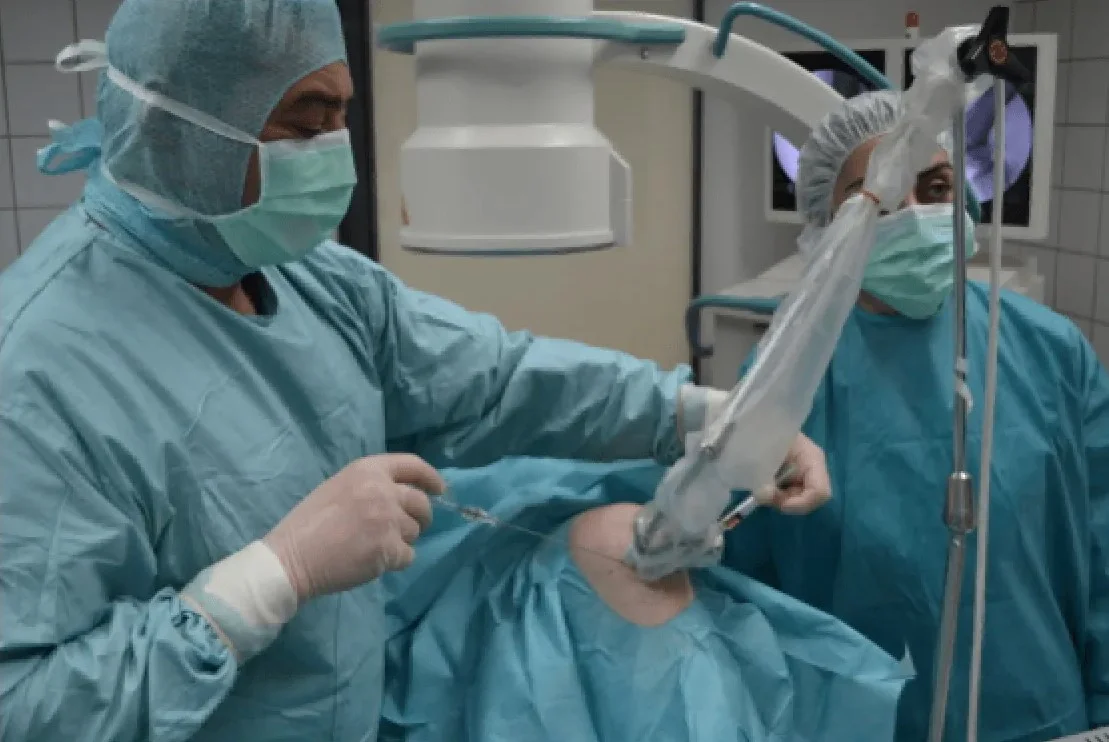
Under Sono Control Arm™ guidance, concentrates are injected directly into damage zones — medial/lateral compartment, patellofemoral region, menisci area, subchondral cysts.
Regeneration
Stem cells differentiate into chondrocytes, synthesis of new cartilage matrix begins. Growth factors reduce inflammation, improve blood supply. After 3-6 months — cartilage restoration visible on follow-up MRI.
Why MIBRAR® is effective for knee osteoarthritis
Knee osteoarthritis was considered irreversible: cartilage is destroyed and cannot be restored. Traditional medicine offers painkillers, "lubricants" (hyaluronic acid), and ultimately — joint replacement. MIBRAR® changes this paradigm — true cartilage regeneration of the knee joint is possible for the first time.
Mechanism of Action in Knee Osteoarthritis:
- Chondrogenesis — Lipogems® stem cells differentiate into chondrocytes and synthesize hyaline cartilage (type II collagen, proteoglycans)
- Anti-inflammatory Effect — suppression of chronic inflammation accelerating destruction (reduction of IL-1β, TNF-α, MMP-13)
- Meniscus Regeneration — simultaneous restoration of damaged menisci, recovery of shock absorption
- Synovial Fluid Normalization — improved lubrication and cartilage nutrition
Key Difference: MIBRAR® is not a "lubricant" or pain reliever. It is biological regeneration, confirmed by follow-up MRI: increased cartilage thickness, reduced subchondral edema, restoration of joint space.
MIBRAR® for Knee Osteoarthritis
- Both knees at once — + hip joints + spine
- Sono Control Arm™ — precise navigation
- Without anesthesia — local anesthesia
- Sports without restrictions — after recovery
- Does not interfere with joint replacement — if needed later
Treatment Results for Gonarthrosis
Follow-up MRI scans demonstrate cartilage tissue regeneration and joint space restoration after the MIBRAR® procedure.

MIBRAR Case: Male, 49 years
Diagnosis: Medial arthrosis grade IV, osteonecrosis of the medial femoral condyle, meniscus degeneration. After unsuccessful abrasive arthroplasty, condition worsened sharply — could only move on crutches.
Result at 18 months: Osteonecrosis and bone tissue edema completely resolved. Full reconstruction of meniscus and cartilage layer. After 8 weeks — sports without restrictions.
View case study →
Same patient — coronal view
Coronal MRI: green circle marks the osteonecrosis zone (dark area in medial condyle). Cartilage destruction, joint effusion.
At 18 months: Osteonecrosis completely resolved, cartilage layer reconstructed. Joint replacement was not needed — knee is fully functional.
View case study →MIBRAR® Method Advantages
95% of interventions covered
MIBRAR® covers up to 95% of all spinal neurosurgery and orthopedic operations.
No anesthesia or incisions
Outpatient treatment via 0.3-1.5 mm puncture. No general anesthesia or hospitalization.
No age restrictions
Regeneration at any age. Safe for chronic conditions and anesthesia intolerance.
Rapid improvement
Concentrates have analgesic and anti-inflammatory properties. Relief within days.
Multiple zones at once
Simultaneous treatment of multiple discs or joints in one procedure.
Home the same day
No crutches, braces or rehabilitation needed. MRI follow-up at 8-16 weeks.
MIBRAR® Technology
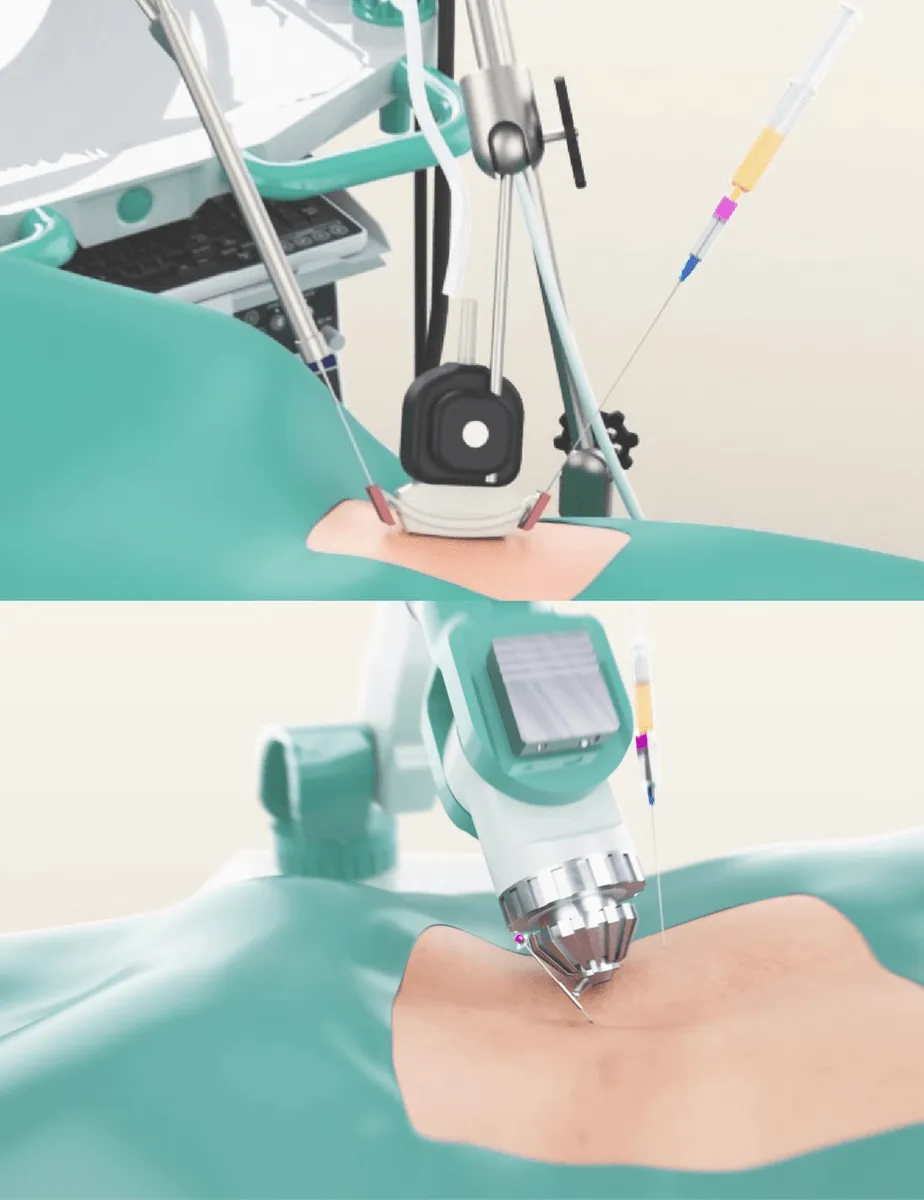
Cyber Navi Hand™
Intraoperative robotic navigation system. Provides precise access to deep structures with 1 mm and 1 degree accuracy.

Sono Control Arm™
Device for intervention under sonographic control. Eliminates open surgeries with real-time visual monitoring.