 Русский
  English
  Deutsch
  Español
  العربية
  中文
中文  Türkçe
  Français
  Italiano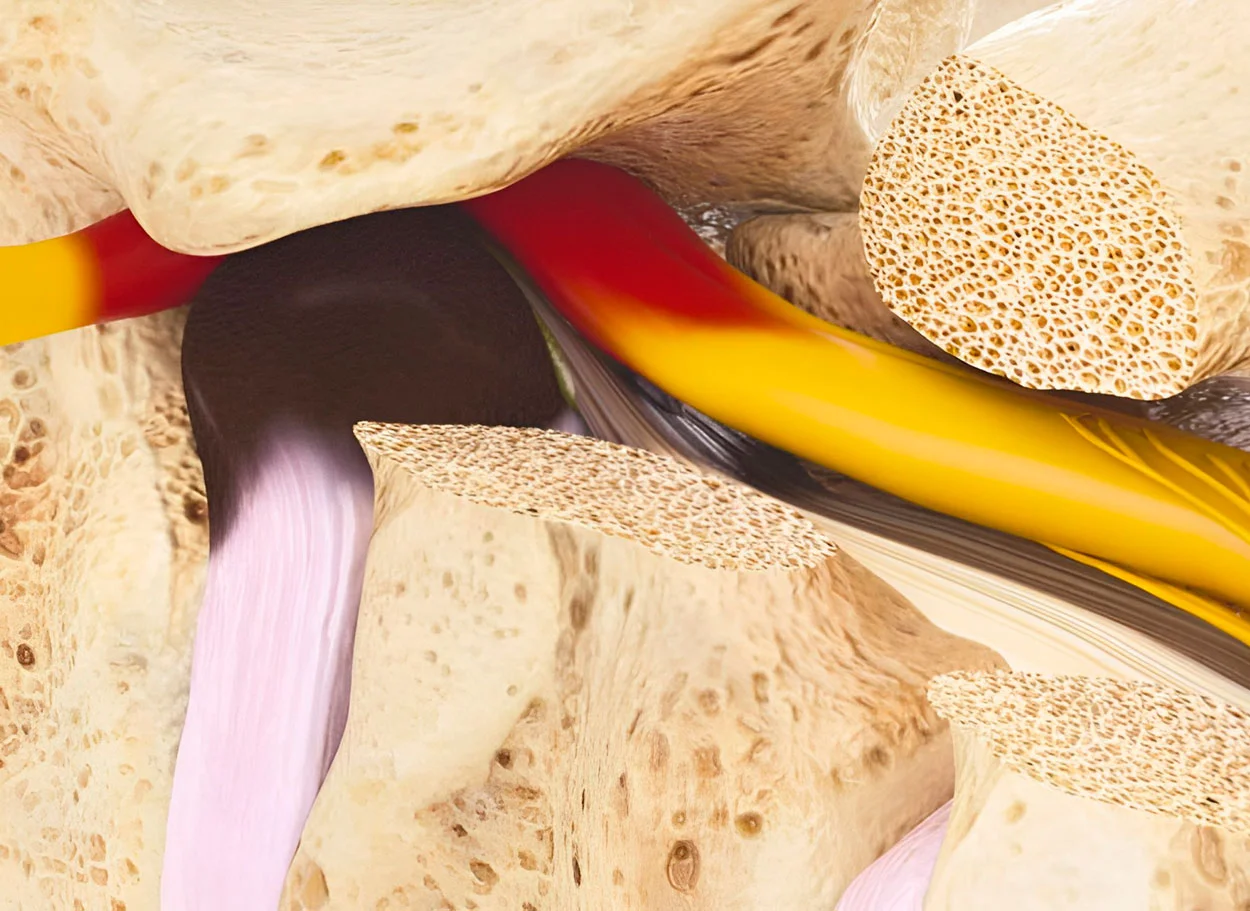
What is Facet Joint Syndrome?
Facet Joint Syndrome (spondylarthrosis) is a degenerative disease of the intervertebral (facet) joints accompanied by chronic back pain. Each vertebra is connected to its neighboring vertebra through two facet joints — these are precisely what provide stability and controlled mobility of the spine.
According to research, Facet Joint Syndrome is the cause of 15-45% of all cases of chronic lower back pain and up to 55% of chronic neck pain. It is one of the most underestimated causes of back pain — often masquerading as a herniated disc or sciatica.
Causes of development:
- Cartilage degeneration — thinning and destruction of articular cartilage with age
- Joint overload — when disc height decreases, load on facet joints increases by 30-70%
- Inflammation — chronic synovitis with joint capsule swelling
- Osteophytes — bone spurs that limit mobility
- Capsular hypertrophy — thickening of the joint capsule that narrows the spinal canal
Facts About Facet Joint Syndrome
- ICD-10: M47.8
- Frequency: 15-45% of chronic lower back pain
- In cervical spine: up to 55% of chronic pain
- Age: more common after age 40
- Association: in 70% of cases accompanies disc degeneration
Symptoms of Facet Joint Syndrome
Lumbar Spine
- Dull, aching lower back pain
- Worsening with extension and rotation
- Pain radiating to buttocks and thighs
- Morning stiffness (15-30 minutes)
- Relief with forward bending
- Inability to stand for long periods
Cervical Spine
- Neck pain with radiation to shoulders and shoulder blades
- Limited head rotation
- Occipital headaches
- Crepitus with neck movements
- Paravertebral muscle tension
Differences from disc herniation
- Pain worsens with extension (with herniation — with flexion)
- No typical sciatica (pain along the nerve into the leg)
- Pain is more localized, without clear radiation
- Muscle spasm — leading symptom
- Often combined with disc degeneration
Comparison of treatment methods
| Criterion | Steroid blockades | Radiofrequency denervation | MIBRAR® |
|---|---|---|---|
| Principle | Suppression of inflammation with steroids | Destruction of joint nerve | Regeneration of cartilage and joint capsule |
| Duration of effect | 2-8 weeks | 6-12 months (nerve regenerates) | Years (structural regeneration) |
| Is the joint restored? | ❌ No — only inflammation relief | ❌ No — nerve destroyed, joint continues to deteriorate | ✅ Yes — regeneration of cartilage and capsule |
| Repeat procedures | Every 2-4 weeks | Every 6-12 months | Usually not required |
| Side effects | Osteoporosis, tissue atrophy (steroids) | Sensory loss, muscle weakness | Minimal — own cells |
How MIBRAR® treats Facet Joint Syndrome
Diagnosis of affected joints
MRI and CT are analyzed by the Cyber Navi Hand™ system. All affected facet joints are identified, along with the degree of osteoarthritis, presence of associated disc degeneration and stenosis. A treatment plan is created for each joint.
Obtaining regenerative concentrates
From blood — CGF with cartilage growth factors and anti-inflammatory cytokines. From adipose tissue — Lipogems® with mesenchymal stem cells capable of differentiating into chondrocytes.
Intra-articular injection
Under navigational control, concentrates are injected directly into the cavity of each affected facet joint. Surrounding tissues are simultaneously treated — capsule, ligaments, paravertebral muscles. With associated disc degeneration — also injected into the discs.
Joint regeneration
Stem cells restore the cartilage covering of joint surfaces, reduce inflammation of the synovial membrane, normalize synovial fluid production. Result — restoration of joint function without their destruction.
Why MIBRAR® is better than denervation
Radiofrequency denervation (rhizotomy) is the most popular treatment for Facet Joint Syndrome. But its principle is paradoxical: destroy the nerve so the patient doesn't feel pain. The joint continues to deteriorate, the patient just doesn't notice it. After 6-12 months, the nerve regenerates, pain returns, requiring repeat procedure.
MIBRAR® works differently:
- Cartilage restoration — stem cells differentiate into chondrocytes and synthesize new cartilage on joint surfaces
- Inflammation reduction — anti-inflammatory cytokines suppress chronic synovitis without steroids
- Normalization of synovial fluid — improved lubrication and joint nutrition
- Capsule strengthening — growth factors strengthen the stretched joint capsule
Result: the joint not only stops hurting — it restores its structure and function. Nerves remain intact, sensation is preserved, mobility is restored.
MIBRAR® vs Denervation
- Denervation: destroys the nerve → joint continues to deteriorate
- MIBRAR®: restores the joint → pain resolves naturally
- Denervation: repeat every 6-12 months
- MIBRAR®: typically 1 procedure
Treatment Results for Facet Syndrome
Follow-up imaging confirms facet joint regeneration and inflammation resolution after the MIBRAR® procedure.

MIBRAR Case: female, 43 years
Lateral fluoroscopy: 3 images show precise CGF and Lipogems® delivery into facet joints at L3-S1 levels. Color markings indicate each treated level.
Result: facet cartilage surface regeneration, edema and inflammation reduction. Complete pain resolution within one week.
View case study →
Same patient — frontal projection
AP fluoroscopy: 3 images in frontal projection show CGF and Lipogems® delivery into facet joint capsules and intervertebral discs. Green markers — injection points.
MIBRAR® advantage: all levels from L3 to S1 treated in a single procedure. Unlike denervation — joints are restored, not just numbed.
View case study →MIBRAR® Method Advantages
95% of interventions covered
MIBRAR® covers up to 95% of all spinal neurosurgery and orthopedic operations.
No anesthesia or incisions
Outpatient treatment via 0.3-1.5 mm puncture. No general anesthesia or hospitalization.
No age restrictions
Regeneration at any age. Safe for chronic conditions and anesthesia intolerance.
Rapid improvement
Concentrates have analgesic and anti-inflammatory properties. Relief within days.
Multiple zones at once
Simultaneous treatment of multiple discs or joints in one procedure.
Home the same day
No crutches, braces or rehabilitation needed. MRI follow-up at 8-16 weeks.
MIBRAR® Technology
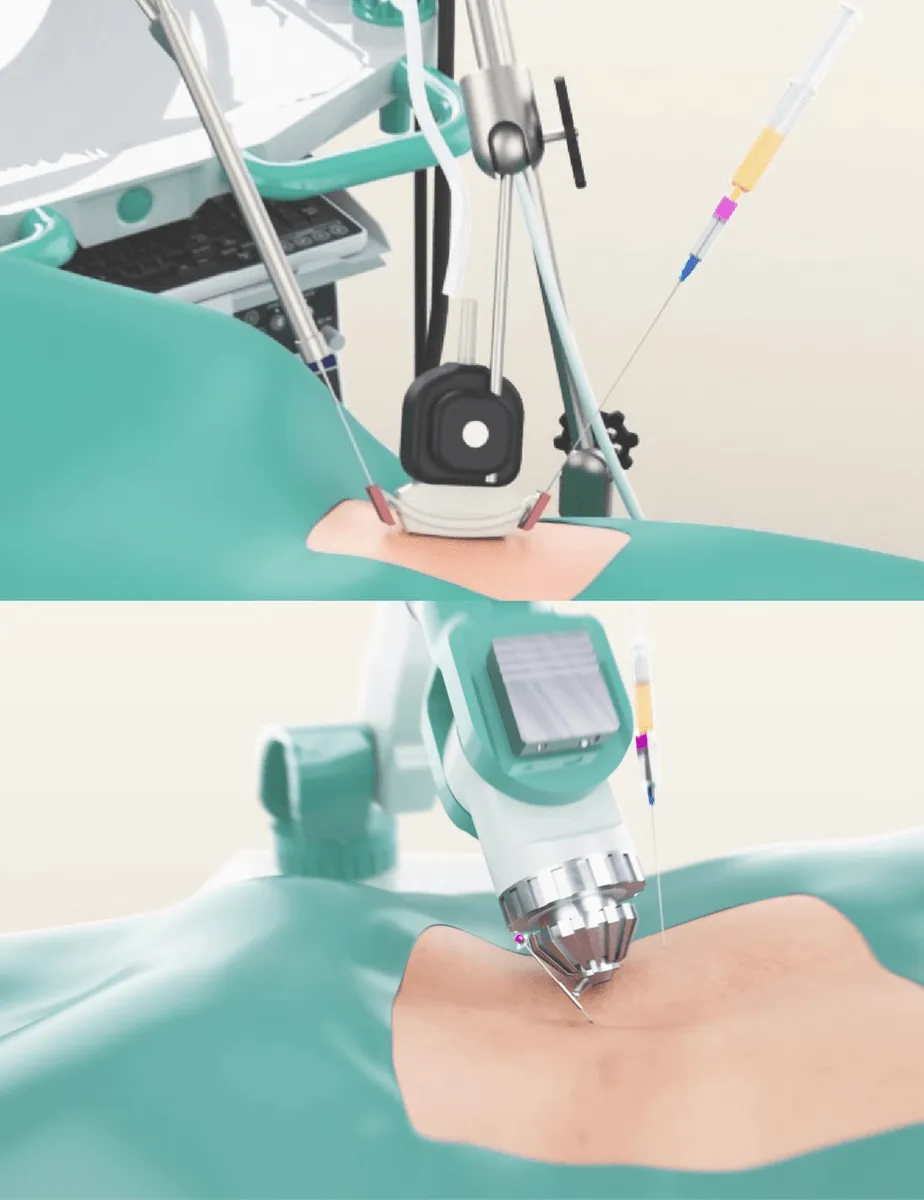
Cyber Navi Hand™
Intraoperative robotic navigation system. Provides precise access to deep structures with 1 mm and 1 degree accuracy.

Sono Control Arm™
Device for intervention under sonographic control. Eliminates open surgeries with real-time visual monitoring.