
 Русский
  English
  Deutsch
  Español
  العربية
  中文
中文  Türkçe
  Français
  Italiano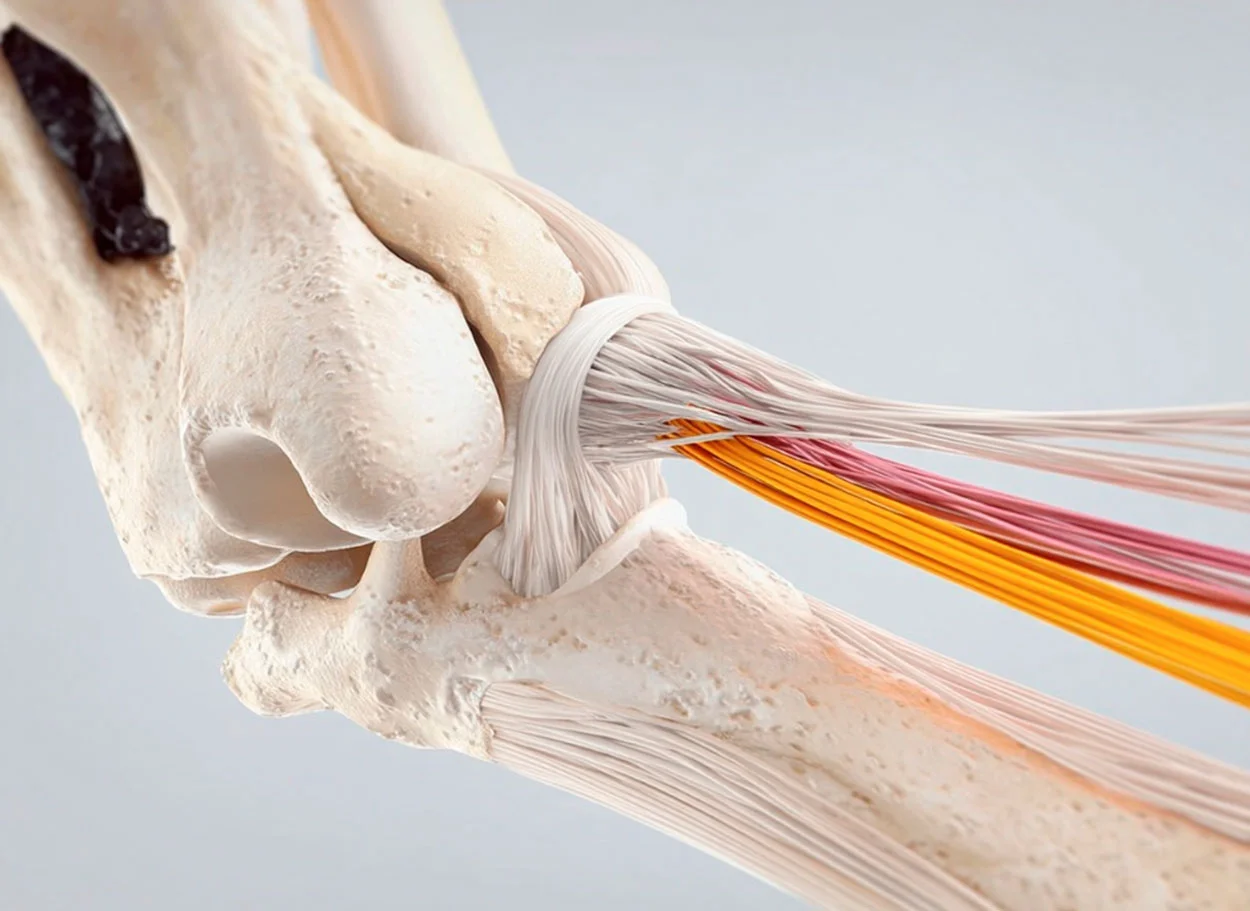
Video about the MIBRAR® Method
What is epicondylitis
Epicondylitis is a degenerative lesion of tendons at their attachment to the epicondyles of the humerus. Contrary to the name "tendinitis" (inflammation), chronic epicondylitis is dominated not by inflammation but by degeneration — angiofibroblastic dysplasia of tendon tissue (tendinosis). This is why cortisone provides only a temporary effect.
Two types of epicondylitis
Lateral epicondylitis ("tennis elbow")
Lesion of wrist extensor tendons (primarily m. extensor carpi radialis brevis) in the area of the lateral epicondyle. Pain on the outer side of the elbow, worsens with gripping, turning a doorknob, handshake, lifting a cup. ICD-10: M77.1. Prevalence: 1-3% of the population, peak 35-55 years.
Medial epicondylitis ("golfer's elbow")
Lesion of flexor-pronator tendons in the area of the medial epicondyle. Pain on the inner side of the elbow, worsens with wrist flexion, pronation, gripping. ICD-10: M77.0. 5-10 times less common than lateral. Common in golfers, throwers, programmers.
Stages of the disease
1. Acute tendinitis (0-6 weeks)
Tendon inflammation. Pain with loading, minimal at rest. At this stage, spontaneous recovery is possible with elimination of the provoking factor.
2. Tendinosis (6 weeks - 6 months)
Degeneration of tendon tissue: collagen disorganization, neovascularization, angiofibroblastic hyperplasia. Pain with normal loads. Cortisone at this stage further damages the tendon.
3. Chronic tendinosis with partial tears (over 6 months)
Partial tendon tears, calcification. Constant pain, significant loss of grip strength. Traditional medicine offers surgery. MIBRAR® regenerates the tendon even at this stage.
Why cortisone is not the solution
Temporary effect
Meta-analysis by Coombes et al. (2010, Lancet): cortisone injections provide relief for 2-6 weeks, but after 6-12 months results are worse than without treatment. Cortisone suppresses inflammation but accelerates collagen degeneration.
Risk of rupture
Repeated cortisone injections into the tendon increase the risk of complete rupture. Cortisone inhibits collagen synthesis and reduces tendon strength.
Vicious cycle
Pain returns, requiring a new injection. Each time the effect is shorter, and the tendon weaker. MIBRAR® breaks this cycle by regenerating the tissue.
Treatment of epicondylitis using the MIBRAR® method
MIBRAR® initiates true regeneration of tendon tissue — unlike cortisone, which only suppresses symptoms.
1. Ultrasound Diagnosis
High-frequency ultrasound visualizes: degree of tendon damage, neovascularization, partial tears, calcific deposits. The exact injection site is determined.
2. CGF Preparation
From 10-20 ml of patient's blood, CGF is isolated — concentrate of growth factors in a fibrin matrix. PDGF, TGF-beta, VEGF, IGF-1 — key for tendon regeneration.
3. Targeted Injection under Ultrasound Guidance
CGF (in severe cases + Lipogems®) is injected under ultrasound control directly into the tendon degeneration zone. Injection accuracy is key to effectiveness.
4. Regeneration
Stem cells differentiate into tenocytes (tendon cells). Growth factors stimulate type I collagen synthesis — the main structural protein of tendons. Follow-up ultrasound at 3-6 months shows restoration of normal echostructure.
Stop tolerating elbow pain
If cortisone doesn't help — regeneration is needed, not inflammation suppression.
Book a consultationQuestions about epicondylitis
Yes. MIBRAR® regenerates the damaged tendon without surgery. Surgery is indicated only for complete tendon tear or ineffective conservative treatment for more than 12 months.
One 15-20 minute procedure. Improvement in 2-4 weeks. Full effect — 3-6 months. In 80% of cases, 1 procedure is sufficient; sometimes a repeat is needed after 4-6 weeks.
Chronic epicondylitis is tendon degeneration (tendinosis), not inflammation. Cortisone suppresses inflammation but accelerates collagen breakdown. Regeneration is needed, not anti-inflammatory therapy.
Office work — after 2-3 days. Light physical activity — after 2 weeks. Sports with arm loading (tennis, golf) — after 6-8 weeks with gradual intensity increase.