
 Русский
  English
  Deutsch
  Español
  العربية
  中文
中文  Türkçe
  Français
  Italiano
  Prof. Dr. med. Arsen Babayan
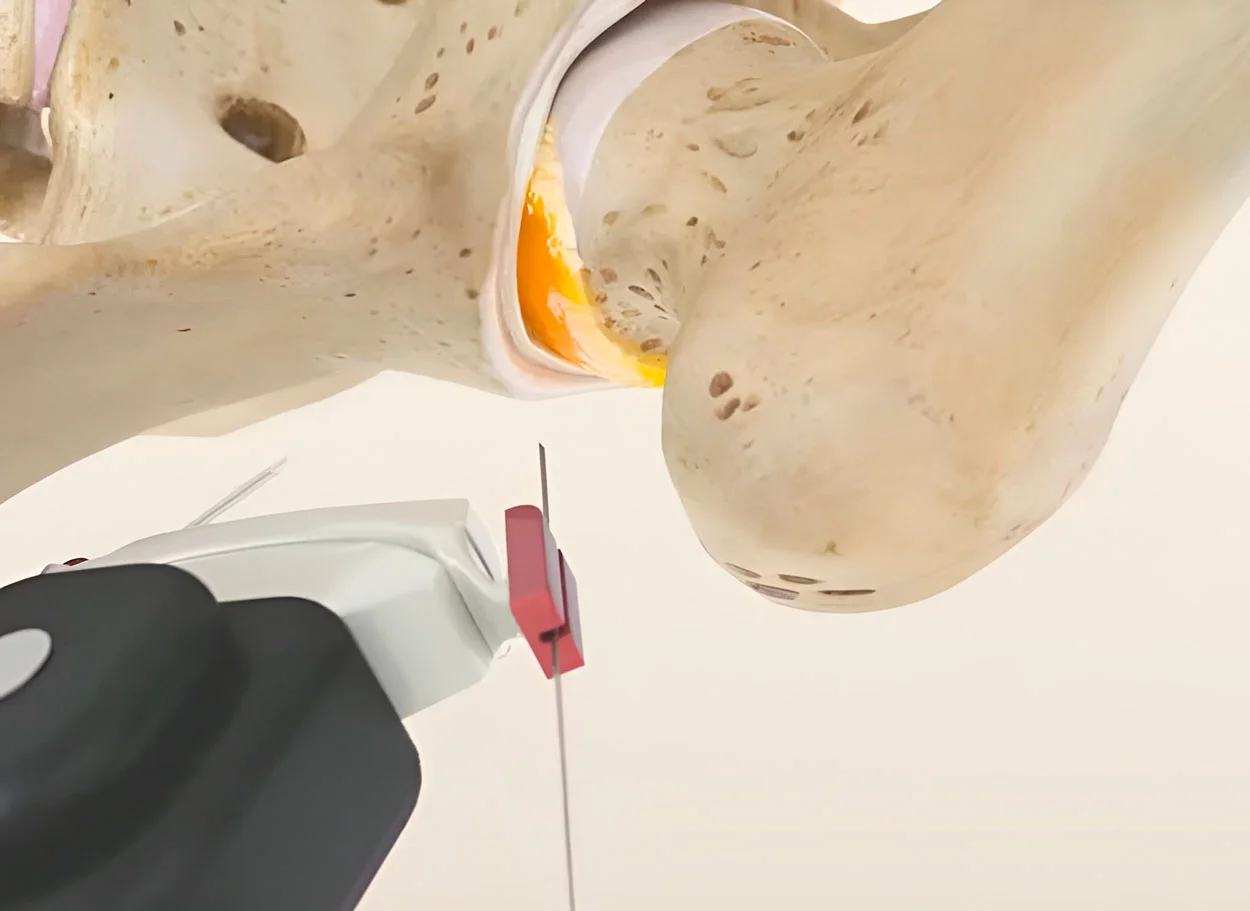
Joint replacement is one of the most successful operations in medical history. But it is an irreversible procedure: after joint replacement, there is no way back. How to know if the moment has come — or if there is still an alternative?
Sign 1: Pain at Rest and at Night
If the joint hurts not only during activity but also at rest — especially nighttime pain that wakes you up — this is a signal of serious destruction. In early stages of osteoarthritis, pain occurs only during activity and subsides at rest.
Sign 2: X-ray Shows “Bone-on-Bone”
The joint space on X-ray is completely absent — bones are rubbing against each other (Kellgren-Lawrence IV). This is an objective criterion that is hard to ignore. However: even with KL-IV, some patients retain acceptable function.
Sign 3: Range of Motion Limited >50%
Normal knee flexion is 130–150°. If less than 90° is available — quality of life suffers (cannot sit normally, climb stairs). For hip: inability to put on socks or shoes.
Sign 4: Leg Axis Deformity
Varus (bow-legged) or valgus (knock-kneed) deformity >15° creates uneven loading and accelerates destruction. Correction without prosthesis (osteotomy) is possible only in early stages.
Sign 5: NSAIDs No Longer Help
If ibuprofen, diclofenac, and other painkillers no longer relieve pain or require maximum doses — the inflammatory process is beyond medication control.
Sign 6: Walking Distance < 500 Meters
If you cannot walk 500 meters without stopping due to pain — this is significant functional limitation. Standard test: 6-minute walk test (6MWT).
Sign 7: You Avoid Daily Activities
Stopped going to the store, avoid stairs, gave up walks. Social isolation due to pain is a serious indicator.
Sign 8: Joint Instability
Sensation that the knee “gives way” or the hip joint “pops out.” This indicates destruction of the ligament apparatus and joint capsule.
Sign 9: Avascular Necrosis of Bone
Avascular necrosis of the femoral head stages III–IV (collapse of the joint surface) is a direct indication for joint replacement. In early stages (I–II), regenerative therapy can slow progression.